By Brent Handy & FSPA Builders Council
The mission of the FSPA is to bring professionalism to our wonderful swimming pool industry here in Florida. The Builders Council at the FSPA has identified another way for the collective experience of the council members to deliver “best practices” information to our industry. This nugget of information centers directly around a subject that every contractor must decide how to best handle for their company, “When do you collect money during the pool build journey?”
Obviously, a bit of a balance is needed here. If a contractor told a homeowner, “Pay the entire cost of the pool upfront, and then I will come build your pool,” although this might not technically be illegal, this would not be an example of industry best practices. Similarly, if a homeowner told a contractor, “Build my entire pool, and as soon as I’m swimming, I will pay you for the pool,” this would be another example of no-good practices. So let us have the construction draw schedule conversation. At what points along the construction process should a payment be collected, and how much should the payment be?
The first thing that needs to be very clearly stated is: This article is not advice! Nobody has to follow these suggestions. These are simply broad suggestions meant to provide a framework for a contractor to reference.
Let’s also talk about a couple of additional assumptions that apply to our best practices draw schedule framework. This framework specifically applies to concrete pools. If you are contracting a fiberglass pool or vinyl liner pool installation, then you would have different progress points to trigger draws. This framework was molded around a basic pool installation. There are a bunch of other items that could impact the draw schedule if they apply to the contracted work. A couple of examples include: a screen enclosure, some water features, an outdoor kitchen, a pergola, landscaping, etc.
Lastly, every contractor needs to figure out how many draws they want to define. There is no right answer! Every job will have a down payment or deposit; and every contract will have a final payment. Some contractors like to have more collection points along the construction path. Others prefer to only have a couple of larger draw points. Ultimately, there are only two things that are very important: The sum of the draws must equal the exact contract amount, and both the contractor and the homeowner must agree on the draw schedule prior to starting the job.
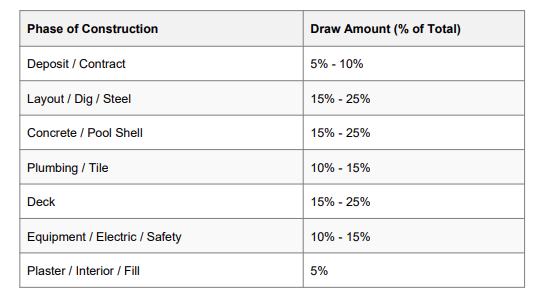
Now that the stage has been set, let’s dive into the good stuff. Our best practices guideline for the down payment or deposit on the contract is 5% to 10% of the job total. This is the one draw that Florida code has something to say. Florida code does not limit how much a contractor can request as a deposit. The Florida code does say that if the deposit is more than 10%, then the contractor must apply for permitting within 30 days, and must begin construction within 90 days of the permit issuance, unless some additional specific criteria is applicable.
Our collective wisdom has identified five common draw trigger phases, and a percentage range of the total contract value for each phase. Layout \ Dig \ Steel 15%-25%, Concrete \ Pool Shell 15%-25%, Plumbing \ Tile 10%-15%, Deck 15%-25%, Equipment \ Electric \ Safety 10%-15%. Again, adjust these to fit your needs.
And last but certainly not least is the final payment. Our collective suggestion is to have a 5% final draw due. We have chosen to call this 5% draw Plaster \ Interior \ Fill. Another pro tip is to correlate this draw to a specific event, and not something ambiguous like final or completion. Some ideas could include “filtration system start-up” or “pool school” or “permit final inspection.”
In closing, there are a couple of housekeeping notes that are prudent to reiterate: This guideline does not establish a binding requirement for FSPA members or any swimming pool contractor in the State of Florida. Lein releases should be provided to the homeowner upon request at each draw phase. Every contractor is responsible for drafting the language of their contracts. Contractors should seek legal counsel for advice and compliance when drafting legal documents.