By Kim Nash, Almar Jackson Pools, Inc.
When you’re meeting with a property manager or HOA Board about an upcoming commercial pool renovation project, chances are their primary focus is on aesthetic changes the community would like to see to make the swimming pool a more visually appealing and inviting space. However, the finishes are typically the easy part. There are many factors they have likely not considered, but must come first before the “fun stuff.”
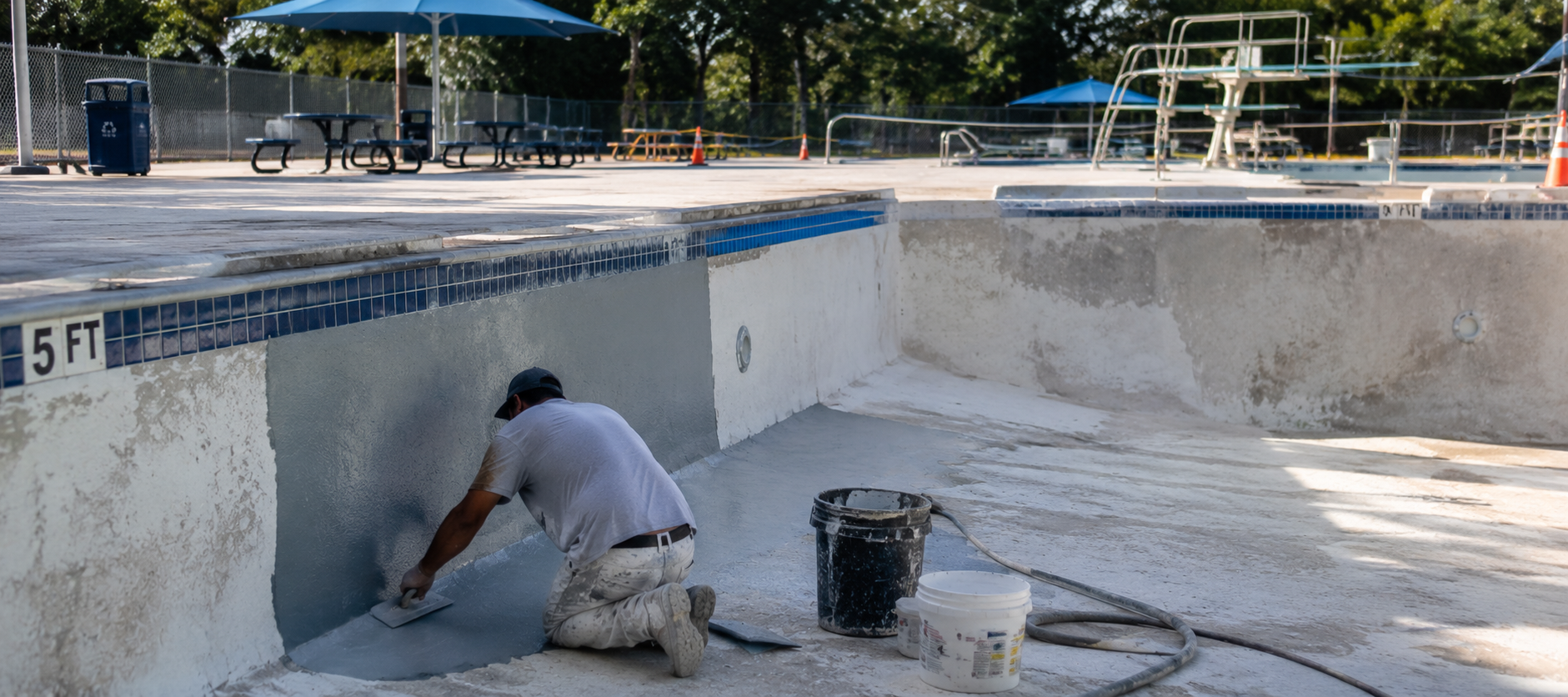
When renovating a commercial pool, even if your project only involves resurfacing, the contractor is responsible for addressing any potential code violations, ensuring the pool is left safe and operable according to Department of Health regulations. Even if a pool is actively operating with certain components not in compliance with DOH standards, as soon as you resurface or renovate an existing pool, it triggers mandatory updates, ensuring the pool adheres with all current regulations.
A common issue that can be easily overlooked without the proper guidance is permissible step tile. Commercial pools require a visible, contrasting, demarcation tile. Wherever there is an egress (such as a step or ladder), that tile must be non-skid.
All risers must also be uniform in height and width within a 1/2 inch. If you are remodeling an existing structure and the steps are not uniform, replastering without rectifying that issue may result in a failed inspection at the end of the project.
Slope breaks also require markings (and depending on the depth at the slope break, may require non-skid tile markers as well). Commercial pools with slope breaks will also require a safety line installed 2 feet before the marking.
Existing ladders are another area to carefully inspect before taking on a commercial renovation project. If the existing ladder is non-cross-braced, it must be replaced with a cross-braced ladder with a 3 to 6 inch clearance from the wall. Protruding step treads in the wall do not adhere to codes, and must be replaced with a cross braced ladder or reconstructed to meet code.
Pool gutters can be complicated during a resurfacing, as they must be leveled to within a 1/4 inch between the highest to lowest points, and the downward slope to the drain must be maintained as originally designed (or increased). If you are plastering a gutter, you must consider the slope ahead of time.
New required upgrades include updates to handrails, waterproofing above-grade concrete pool walls and floors, and the total surface area of gutter grates.
Having a comprehensive understanding of current DOH regulations for commercial swimming pools is crucial for any contractor undertaking a renovation project. But it is perhaps equally important to educate the client on these requirements well before the pool is drained. Many of these updates come at a cost. Proper planning helps to prevent unending change orders and price creep, but renovation projects are also oftentimes unpredictable. What you see may present a different story once you start chipping away tile, and equipment that was fully functional prior to being shut down for the duration of the project, may no longer function when the pool is fired up. Taking the time to explain this before the project starts helps to set proper expectations and prevents uncomfortable conversations about a swimming pool they can’t reopen.